The rock under the city
Toowoomba sits on the basalts of the Main Range Volcanics, the lava flows that built the Great Dividing Range here, with an east-facing escarpment dropping away to the Lockyer Valley. That is the description in Willey's urban geology of the Toowoomba conurbation, and it is the starting point for everything under a Toowoomba house. The city centre is at about 691 m above sea level and the airport at 641 m. Basalt weathers into two very different soils depending on where it sits and how it drains, and the two soils behave differently under a stump.
On the Range and the higher ground the basalt has weathered into the deep red soil that Toowoomba's gardens are known for. On the flatter country to the west and in the lower parts of the city, and across the Darling Downs beyond, the same parent rock has produced the heavy black clay of the plains. A single suburb can have both, and a single block can grade from one to the other.
Two soils, two behaviours
The Queensland Government's soil types page describes both. Ferrosols are well-drained red or yellow-brown volcanic soils found along the Great Dividing Range. Vertosols, the cracking clays of the Darling Downs, are the most common soil in Queensland. The names are the state's; what follows is what they mean for a house.
| Soil | Where it tends to sit | What it does under a house |
|---|---|---|
| Ferrosol, the red volcanic soil | The Range, the higher parts of the city, the escarpment edge | Drains well, so timber stumps last longer in it and the ground moves less with the seasons. Digs cleanly. Stumps in it fail from age, termites or shallow setting more than from heave. |
| Vertosol, the black cracking clay | The lower ground, the plains west of the city, the Downs | Swells after summer storms and shrinks through a dry winter, opening wide cracks at the surface. A house on it rises and falls a little every year. Holds water against hardwood stumps. Needs deeper footings and good drainage. |
| Weathered basalt close to the surface | Patches across the Range | Hard digging. Stump holes can need a breaker. Once the stump is on it, a stable base. |
| Fill | Older blocks that have been cut and filled, creek flats, built-up garden beds | Unpredictable. A stump on fill settles until it finds something firm. The soil test says how deep that is. |
Builder guidance, as distinct from an official survey, sorts sites into the reactive soil classes used for footing design, and one builder's guide puts black and dark brown Darling Downs soils and parts of Toowoomba in the highest class, with over 75 mm of expected movement, red and brown silty soils in a moderate class, and some silty clays in the Toowoomba area in the highly reactive classes between. That is a general picture, not a map. No class belongs to a named suburb; the soil test classifies the site, and council requires a soil classification report with plumbing applications for the same reason. If an engineer is designing footings for a restump, a raise or underpinning on your block, the classification on that report is the one that counts.
The climate that drives the clay
Clay moves because water comes and goes, and Toowoomba's water comes in summer and goes in winter. The Bureau of Meteorology's Toowoomba city station recorded a mean annual rainfall of 952.4 mm between 1869 and 2007. January is the wettest month at 132.1 mm. The mean maximum is 27.6 degrees in January and 16.3 in July; the mean minimum 16.7 in January and 5.3 in July. The newer airport station, recording since 1996, is drier at 740.1 mm a year with December the wettest month at 103.5 mm.
Two recent extremes show the range. In spring 2019 the Darling Downs had its driest spring on record: the airport recorded 23.8 mm for the season against an average of 169.6 mm. The black clay shrank hard that year, cracks opened across yards and stumps were left standing in gaps you could put a hand into. Then on 10 January 2011 two storms merged over the city at about 11 am, the Bureau recorded 60 mm in the hour to 1.50 pm with a peak rate of 144 mm an hour over ten minutes, and East Creek and West Creek overwhelmed the culverts through the city centre, as the Coroner's findings record. Two people died in East Creek. Between those two extremes is the ordinary year: a wet summer that swells the clay and a dry winter that cracks it.
What that does to a house: a stump in clay rises a little after the storms and settles again through winter. If every stump moved the same amount the house would simply go up and down. They do not. The stumps under the downpipe, the leaking shower waste and the garden bed move more than the stumps under the dry side, so the house twists, doors catch and cracks open on a diagonal. A brick house on a slab does the same thing more visibly, because the slab edge drops where the clay dries and the brickwork above it cracks in steps. That is the pattern the signs page describes and the reason underpinning is a different job from restumping.
Drainage: the part that protects the stumps
A new set of concrete or steel stumps in clay will do what the old timber ones did unless the water around them is managed. The aim is simple: keep the moisture under the house as even as possible through the year. On the clay that means stopping water getting in on the wet side and stopping the ground baking on the dry side, and in practice it comes down to a short list.
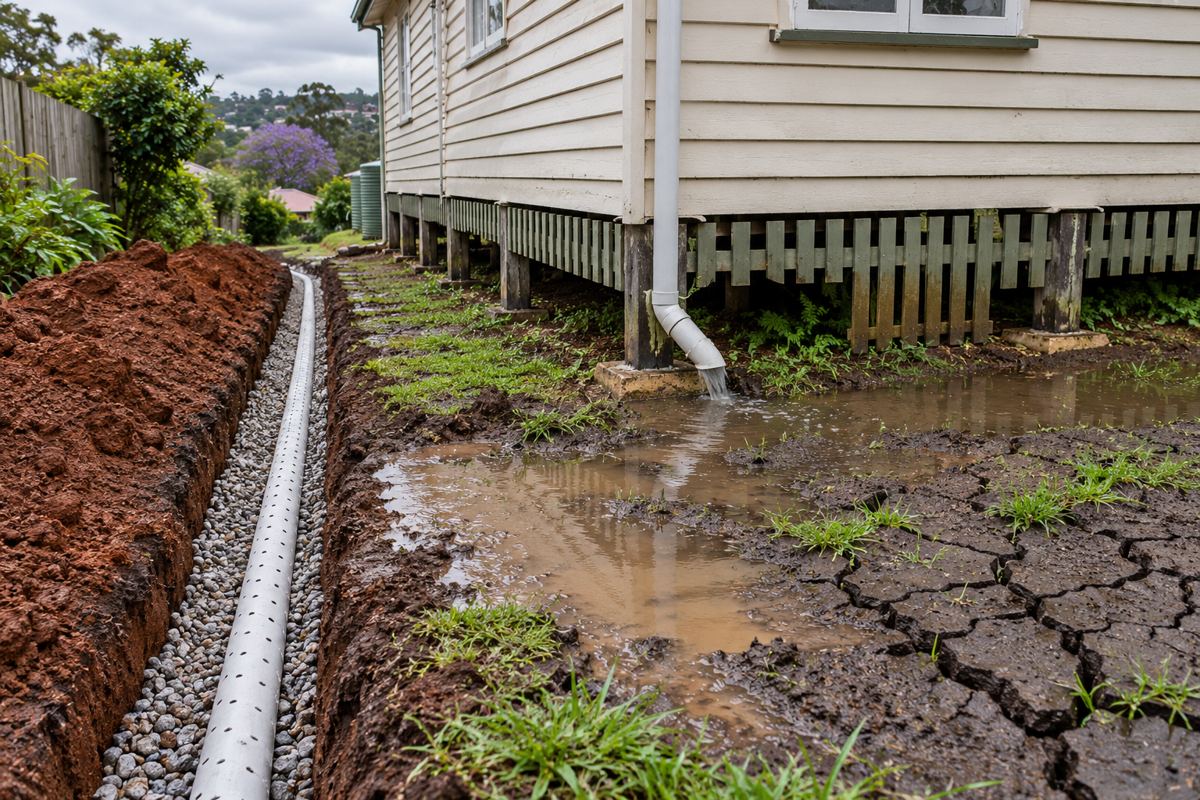
- Downpipes. A downpipe that discharges onto the ground beside a stump is the single most common cause of one corner of a Toowoomba house moving more than the rest. Connect it to stormwater or run it well clear of the house.
- The high side. On a sloping block water runs toward the house from uphill. An agricultural drain, a slotted pipe in a gravel trench, laid along the high side and run to a legal discharge point, intercepts it before it reaches the subfloor. Council's plumbing and drainage applications cover work that connects to its stormwater, and building over or near a council sewer, water or stormwater service needs a separate application.
- Grade under the house. The ground under a Queenslander should fall gently away from the centre so nothing pools. A restump is the time to regrade it, while the crew and the barrow are already there.
- Garden beds and paving. A raised bed against the base of the house keeps that side wet all year. Paving that drains toward the house does the same after every storm.
- Leaks. A shower waste or a tap under the house that has dripped for years keeps one patch of clay swollen while the rest shrinks. Fix it before the stumps go in.
On the red soil the list is shorter, because the ground drains itself, but the downpipe rule still holds: a hardwood stump that stands in a puddle after every storm rots at the ground line whatever the soil, and a concrete stump in the same puddle will tilt as the soil beside it softens. Vents matter too. An enclosed subfloor with the vents blocked by lattice, fill or a garden bed stays damp for weeks after rain, and damp is what termites look for.
None of this is expensive beside the stumps, and it is the reason the stumps last. A quote on clay that has no line for drainage is worth asking about.
The escarpment
The eastern edge of the city is different ground again. The escarpment where the Range drops to the valley is steep, wet on its eastern face and has a long record of slope movement. The Geological Survey of Queensland's Record 1981/02 on land stability on the eastern slopes of Toowoomba documented it, and a University of Southern Queensland report to council on slope instabilities in the escarpment looked at the Fantail and Firetail tracks, Duggan Park and the head of Glen Lomond gully. The planning scheme carries a landslide hazard overlay for steep or unstable land, mapped at maps.tr.qld.gov.au. On a block under that overlay, or on any steep block at the eastern edge of Rangeville, Prince Henry Heights or Mount Lofty, a restump, a raise or underpinning may need a geotechnical engineer before the certifier will issue a permit, and tall stumps on the downhill side are common. The Rangeville page covers that side of town.
What this page cannot do
It cannot tell you what soil is under your house. The ground changes within a street and within a block, and the descriptions here are general. The builder guidance on soil classes is a general picture and this site does not assign a class to any suburb; only a soil test and an engineer's classification of your site do that. It cannot say whether your block is under the landslide or flood hazard overlays; the mapping at maps.tr.qld.gov.au and council's planning team do. And it cannot design drainage. Where a drain connects to council stormwater or runs near a council service, the plumbing and building-over applications are council's and a licensed plumber does the work.
Check the current rules before you rely on this
This page describes the soils, climate and slope conditions that move houses in Toowoomba and the drainage that limits it. It describes the rules in general terms as they stood in October 2026. Standards, forms, thresholds and fines change.
The authoritative sources are Willey, urban geology of the Toowoomba conurbation, Queensland Government, soil types, Stroud Homes on soil classes and building cost, Bureau of Meteorology climate statistics, Toowoomba (city), Bureau of Meteorology climate statistics, Toowoomba Airport and Geological Survey of Queensland Record 1981/02, land stability on the eastern slopes of Toowoomba. Where anything here differs from those sources, they are right and we are not.
We are not building certifiers, engineers, planners or lawyers. For what applies to your house, ask a licensed building certifier or ring Toowoomba Regional Council on 131 872.
Accurate at the time of writing, October 2026. Always check the source before relying on it.