The short answer
Concrete for most houses on the Range. Steel where the floor is low, where the ground is black cracking clay that moves with the seasons, or where the house is likely to be relevelled again. Precast concrete stumps cost less per stump, are unaffected by damp, and carry a cast-in rod that bolts the bearer down. Galvanised adjustable steel stumps cost more, need a concrete pad poured under each one, and can be wound up or down with a spanner for the life of the house, which on the vertosol of the Downs side is worth paying for. Timber is not on our list for Toowoomba. Hardwood stumps did their decades in red loam and fewer in clay, the ground has not changed, and the NCC Queensland variation now asks for termite management with a 50-year design life.
Side by side
| Precast concrete | Galvanised adjustable steel | |
|---|---|---|
| Cost per stump | Lower. Stump, sole plate, ant cap. | Higher. Post, adjustable head, top plate, plus a poured pad. |
| Red ferrosol on the Range | Sits well on a sole plate in a hole that stands up. The usual choice. | Works, but the adjustable head is rarely needed on ground that moves this little. |
| Black vertosol on the Downs | Fixed height. If the clay shrinks and the stump tilts, relevelling means packing again. | Wind the head. Relevel without a dig, every few seasons if the ground keeps moving. |
| Shallow basalt near the escarpment | Hole depth varies across the house; the stump is cut to suit. | Pad poured on rock where it is found; post cut to length. |
| Low clearance under a post-war cottage | Awkward. A long precast post has to be fed sideways into a gap you can barely crawl through. | Easier. Short post, pad poured in place. |
| Fixing to the bearer | Threaded rod cast in, bolted through the bearer. | Top plate coach-screwed or bolted to the bearer. |
| Termites, a problem throughout Queensland | Ant cap on top. Concrete is not eaten. | Ant cap or capped plate. Steel is not eaten. |
| Appearance under a high-set Queenslander | Blocky, and often what the house already has. | Slim. The usual choice where the under-house is open and on show. |
Precast concrete stumps
A square reinforced concrete post, cast with a threaded rod in the top, set in a dug hole on a concrete sole plate and backfilled. The bearer sits on a galvanised ant cap and is bolted down through the rod. Nothing in it rots, rusts or gets eaten, and nothing in the ground around Toowoomba troubles it: the red ferrosol of the Range is a well-drained volcanic soil, as the Queensland Government's soil types page describes it, and the black clay is a movement problem for the hole rather than a chemistry problem for the stump. The limits are practical. A concrete stump is fixed at the height it is set, so if the house settles again the fix is packing. And the stump has to be got under the house, which on a low-set fibro cottage in Wilsonton means feeding a heavy post in sideways through a gap the crew can barely crawl through. For a Queenslander in Newtown or East Toowoomba with room to stand up under the floor and ground that drains, concrete is the obvious choice.
Galvanised adjustable steel stumps
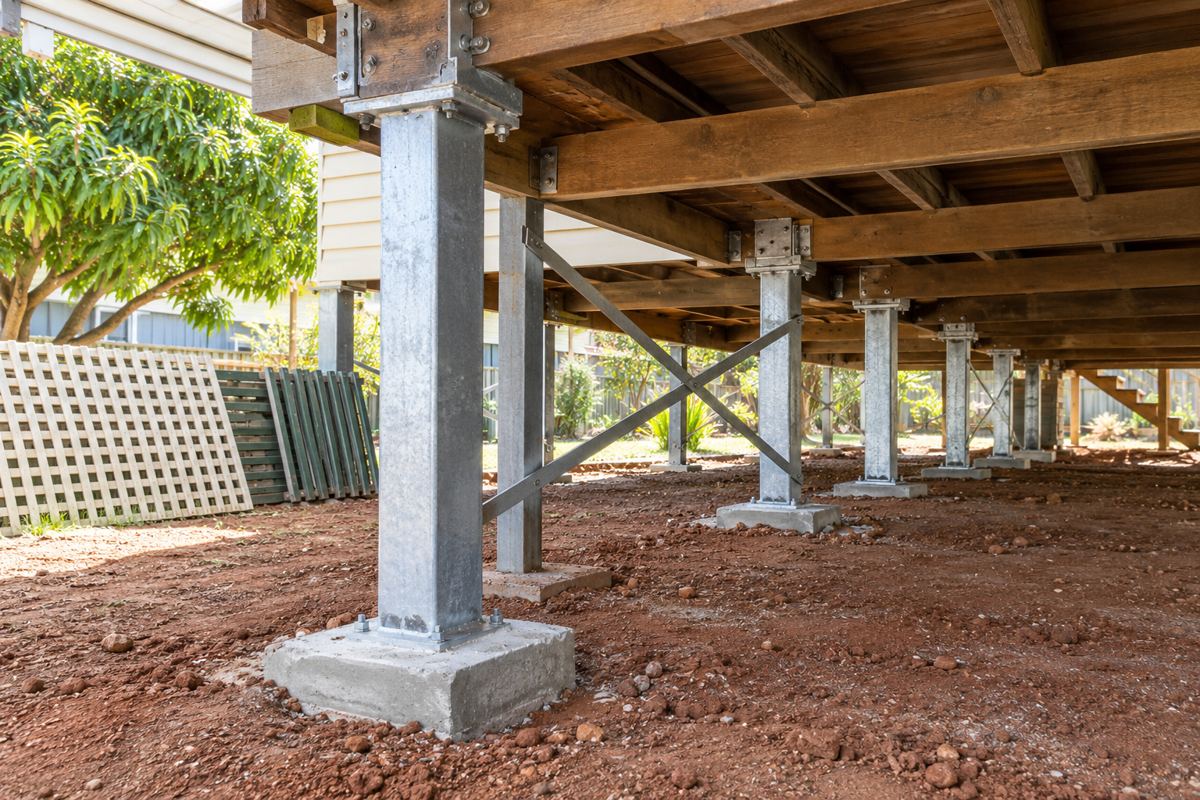
A hot-dip galvanised steel post on a poured concrete pad, with a threaded adjustable head and a steel top plate fixed to the bearer. The pad does two things. It spreads the load on soft ground, and it keeps the steel out of the soil, which matters on the Downs side where the clay holds water for weeks after a storm. Galvanising is a sacrificial coating and steel standing in wet clay goes faster than steel on a pad above it. On a pad, with cross-bracing between the posts and the battens keeping the weather off, hot-dip galvanised steel does well. Painted tube or pre-galvanised sheet is not the same thing and should not be in the quote.
The adjustable head is the reason to pay for them. On the black clay under Harristown, Glenvale and Drayton, where a house relevelled in March can be out again by September as the clay swells through a 132.1 mm January and shrinks through a dry winter, a crew can come back and wind the worst corner up without jacking or digging. Spring 2019, the driest on record on the Darling Downs with 23.8 mm at the airport against a 169.6 mm average, moved a lot of floors on the flat side of town, and the houses on adjustable steel were the easy ones to put right. Steel also wins under a low floor, and under a raised Queenslander where the stumps are on show.
Why not timber
Because the ground has already shown what it does to hardwood. In red loam a stump rots at the ground line, where damp soil meets the air, and stands sound above and below until it is hollow at the one point that matters. In the black clay it stands in water for part of every storm season and in a crack for part of every winter. QBCC describes termites as a problem throughout Queensland, the building code requires a termite management notice in the meter box, and the Queensland variation to the NCC sets a 50-year design life for termite management in new work. Treated pine stumps exist, but in a subfloor that is wet for a season every year they are a shorter answer than concrete or steel at a similar installed price. Restumpers working in Toowoomba do not put timber back under a house unless the owner insists, and most will say why.
Which one where
Ground, not postcode, makes the call, and the soil test classifies the site. Builder guidance cited by one Queensland builder puts black and dark brown Darling Downs soils and parts of Toowoomba in the most reactive class, red and brown silty soils in a moderate one, and some silty clays in the Toowoomba area in between; that is general guidance and not a survey of any suburb. With that caveat, the pattern on the ground is this. On the red ferrosol of the Range through Newtown, East Toowoomba, Rangeville and Mount Lofty, concrete on a sole plate is the usual answer, with steel kept for low verandahs and the odd sleep-out. On the black vertosol of the Downs side through Harristown, Glenvale, Drayton and out to Oakey and Pittsworth, adjustable steel on wide pads on the worst side of the house saves a second dig, and drainage matters more than the stump. Near the escarpment, where the depth to basalt varies across the width of a house and the under-house is often open to view, slim steel on pads is the common choice. The certifier and the builder settle it from the first holes, and the quote should say what changes if the ground is not what the first holes suggested.
Mixing them under one house is common and sensible. Concrete under the body of the house, adjustable steel on the corner that keeps moving or under the bathroom, steel under the low front verandah where there is no room to feed a precast post in, steel under the open side of a high-set house where the stumps can be seen from the street. Each stump is set to firm ground, each bearer is packed to one laser line, and the floor does not know the difference. The building development permit from the certifier covers both, and it names the type and count of each.
What the quote should say
The stump type by name, the number of each, the sole plate or pad under them, hot-dip galvanising if steel, ant caps, the depth the holes will go to, and how the holes will be pumped in clay or broken through rock. It should carry the builder's QBCC licence number, in a class that covers building work on a house, which is Builder Low Rise or higher, because a restump is well over the $3,300 threshold at which a licence is required. It should say whether the job is $20,000 or more, which is a Level 2 contract with a 5% deposit cap, the statutory warranties and the Consumer Building Guide before signing, or between $3,301 and $19,999, which is Level 1 with a 10% cap. It should say the Queensland Home Warranty Scheme premium is included and that the QBCC insurance notice will follow. If the quote just says new stumps, ask which, and ask why.
Two Toowoomba questions belong in the same conversation. The first is character: under a high-set Queenslander in a mapped Neighbourhood Character area of East Toowoomba or Newtown, a change from square hardwood stumps to slim steel posts is visible from the street, and the planning scheme's character overlay applies to those mapped areas and places. There is no blanket pre-1946 rule, but ask council's planning team on 131 872 before deciding, because like-for-like concrete under the same battens is one thing and an open steel undercroft is another. The second is the ground: nobody can tell you the site class from the suburb, and the depth and pad size follow from the soil test rather than from the stump material. The soils guide explains what the test looks for.
What a better stump cannot fix
A stump of any material cannot stop the ground moving. On the black clay the answer is depth, pads and drainage, and steel only makes the relevel afterwards easier. It cannot hold up a bearer that has rotted; that is timber work and its own page. It cannot fix a brick veneer that is cracking on its footings, which is underpinning with an engineer, however good the stump. It cannot settle the character question under a Queenslander in a mapped streetscape; council does that. And no stump material changes whether approval is needed; the certifier decides that from how many stumps are being replaced, not what they are made of.
Check the current rules before you rely on this
This page compares stump materials for houses in Toowoomba and the Darling Downs; the choice is made with the builder on the inspection and shown on the building approval. It describes the rules in general terms as they stood in October 2026. Standards, forms, thresholds and fines change.
The authoritative sources are NCC 2022 Volume Two, Queensland variation H1 (termite management), QBCC on termites in Queensland, Queensland Government, soil types, Stroud Homes on soil classes and building cost, Bureau of Meteorology climate statistics, Toowoomba (city) and QBCC, when you need a licence. Where anything here differs from those sources, they are right and we are not.
We are not building certifiers, engineers, planners or lawyers. For what applies to your house, ask a licensed building certifier or ring Toowoomba Regional Council on 131 872.
Accurate at the time of writing, October 2026. Always check the source before relying on it.