The southern suburbs
Harristown is the oldest of the southern suburbs. Queensland Places records it as subdivided in 1902 and 1910 and expanded after the Second World War, which puts two eras of housing in the one suburb: timber homes from the early decades of the century, some of them Queenslanders on high stumps, and a larger number of post-war timber and fibro houses on stumps, many of them low-set. Kearneys Spring to the south-east is a suburb of the 1970s, which means more brick veneer on concrete slabs and fewer stumps. Drayton, Darling Heights and the estates further south are not dated here; this site describes them only as newer estates and surrounding areas, and the house in front of you says what it is.
What the southern suburbs share is the ground. The city slopes away from the Range to the south and west, and the lower, flatter country is where the basalt has weathered into the black cracking clay rather than the red soil of the higher ground. Not every block, and not every street, but enough that a restumper working in Harristown expects clay and is pleased to find red soil.
Black clay and what it does to a house
The Queensland Government's soil types page calls vertosols, the cracking clays of the Darling Downs, the most common soil in Queensland. They swell when wet and shrink when dry, and the shrinking opens the wide surface cracks that give them their name. Toowoomba's rain comes in summer: the Bureau of Meteorology's city station averaged 952.4 mm a year between 1869 and 2007, with January the wettest month at 132.1 mm and July cool and dry. So the clay swells through the storm season and shrinks through winter, and in a dry year like 2019, the driest spring on record on the Darling Downs, it shrinks hard.
A house on stumps in that clay moves with it. The stumps under the wet side, where the downpipe lands or the shower leaks, rise and fall more than the stumps under the dry side, and the house twists between them. Doors catch, VJ joints open on a diagonal, a gap appears under the skirting on the low side. Hardwood stumps standing in clay that holds water against them rot at the ground line. A brick house on a slab does the same thing at its edges and shows it as stepped cracks. The soils guide covers the mechanism; the signs page covers what it looks like inside.
| Area | What the sources say | What is usually under the house |
|---|---|---|
| Harristown | Subdivided 1902 and 1910, expanded after WWII | Early timber homes and post-war timber and fibro on stumps, many low-set. Hardwood stumps often replaced once with concrete. Black clay on many blocks. |
| Kearneys Spring | A suburb of the 1970s | Brick veneer on slabs and strip footings; some timber. Underpinning and slab-edge movement rather than stumps. |
| Drayton, Darling Heights and the south | Not dated by this site | Older cottages near the old village centre, newer estates further out. The house and the soil test say what applies. |
The work here
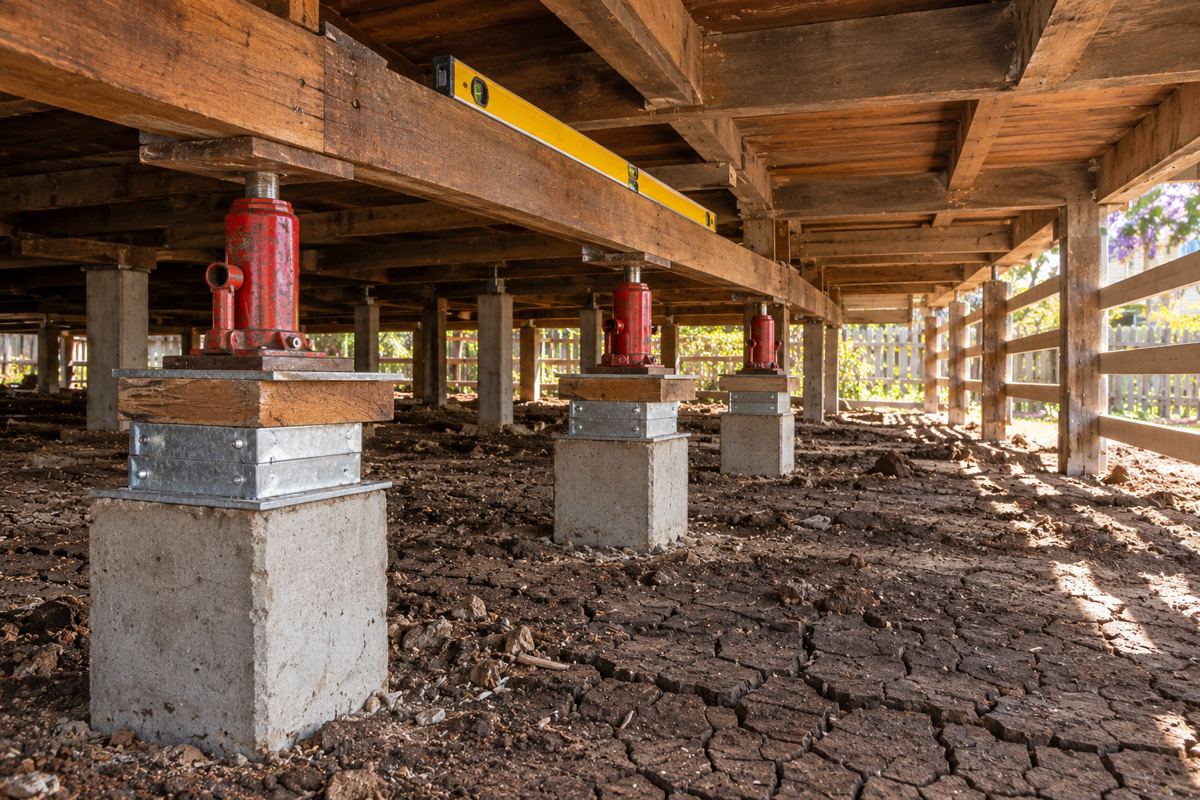
On the timber houses the jobs are full restumps, partial replacement where an earlier concrete restump left some hardwood behind, and a lot of relevelling on houses whose concrete stumps are sound but have settled unevenly on the clay. Relevelling is the job in the photo above: jacks under the bearer, steel packers on the stump tops, a level along the bearer, no digging. It is the right answer when the stumps are good and the wrong one when they are not, and a stump that has been packed three times in twenty years is usually telling you it is the wrong one.
On the brick houses of Kearneys Spring and the newer estates the job is underpinning when the slab or strip footing has moved on the clay. It always needs an engineer's design, and on reactive clay the design usually carries the new footing below the zone that moves with the seasons. Low-set timber houses are the other thing the south has more of than the inner city, and a low-set subfloor with a few hundred millimetres of clearance is dug lying down, which the cost guide lists as the most common reason two similar houses are priced apart.
The post-war low-set house
The house that defines Harristown for a restumper is the post-war low-set timber or fibro home: a timber floor on bearers and joists, stumps a few hundred millimetres high, a base wall of sheeting or battens, and an enclosed subfloor that stays damp for weeks after a storm. It was cheap to build and it has lasted, but everything about it is harder to work on than a high-set Queenslander. The inspection is a crawl with a torch. The stumps are dug lying down. The spoil comes out in buckets. And because nobody has been under it in years, the bearers at the wet corner, under the bathroom and laundry, are usually worse than the owner expects, which is why a quote on one of these houses should carry a rate for bearer and joist timber found once the house is on jacks.
The same house is where termites do the most unseen damage, because an enclosed damp subfloor on black clay is what a colony is looking for. QBCC calls termites a problem throughout Queensland and recommends a yearly inspection; on a low-set house in the south that inspection is the only time anyone looks. The termites page explains what the meter box notice should say and why a restump onto concrete or steel takes away the route through the post.
Drainage on the clay
New stumps in reactive clay last as long as the moisture around them stays even. That is the whole principle, and in the southern suburbs it comes down to a short list. Connect every downpipe to stormwater or run it well clear of the house; a downpipe ending on the ground beside a stump is the most common single cause of one corner moving. On a block that falls toward the house, lay an agricultural drain along the high side and run it to a legal discharge point. Regrade under the house so nothing pools, which a restump is the time to do while the crew is there. Pull garden beds and paving that drain toward the house back from the base wall. Fix the leaking shower waste before the stumps go in, not after.
Where a drain connects to council stormwater, council's plumbing and drainage applications apply and need a soil classification report; building over or near a council sewer, water or stormwater service needs its own application first. A licensed plumber does the connection. Council fast-tracks some plumbing applications in 2 business days and takes up to 10 on others; the fee is set in council's register each year, and this site has not verified it, so ask council.
Approvals and licences
A full restump, any underpinning and any raise is assessable building work under the Building Act 1975 needing a building development permit from a licensed building certifier; replacing a few stumps may be accepted development, and the certifier decides. Council's own building certification team certifies on 4688 6828 alongside private certifiers, and council's advice is that a geotechnical engineer may be needed to test soil and design footings, which on the clay is not unusual. The builder needs a QBCC licence in a class that covers house work for anything over $3,300, and the Queensland Home Warranty Scheme covers structural defects for 6 years 6 months from the contract above the same figure. The approvals page has the rest.
Buying in the south
At the 2021 census 38.4 per cent of dwellings in the Toowoomba urban centre were rented, and the post-war stock of Harristown is a large part of the rental market, which means a share of houses that nobody has looked under for years. If you are buying, the buying guide says to have the subfloor entered rather than viewed through a vent, to read the meter box notice, and to ask council for a plan search covering approved work since 1975. On the clay, add one question: where do the downpipes go.
What this page cannot do
It cannot say what soil is under a particular house in Harristown, Kearneys Spring or the south; the ground grades from clay to red soil within a street, and only a soil test classifies a site. It does not assign a soil class to any suburb. It cannot date Drayton, Darling Heights or the newer estates, because this site has not verified when they were built, and describes them only as older village centres and newer estates. It cannot design footings or drainage on reactive clay; an engineer does that and the certifier approves it. And it cannot give council's current plumbing or building-over fees, which this site has not verified. Ask council on 131 872.
Check the current rules before you rely on this
This page describes restumping, relevelling and underpinning in Harristown, Kearneys Spring, Drayton and the southern suburbs of Toowoomba. It describes the rules in general terms as they stood in October 2026. Standards, forms, thresholds and fines change.
The authoritative sources are Queensland Places, Harristown, Queensland Places, Kearneys Spring, Queensland Government, soil types, Bureau of Meteorology climate statistics, Toowoomba (city), Toowoomba Regional Council, plumbing and drainage applications and Toowoomba Regional Council, building certifiers. Where anything here differs from those sources, they are right and we are not.
We are not building certifiers, engineers, planners or lawyers. For what applies to your house, ask a licensed building certifier or ring Toowoomba Regional Council on 131 872.
Accurate at the time of writing, October 2026. Always check the source before relying on it.