The house you are looking at
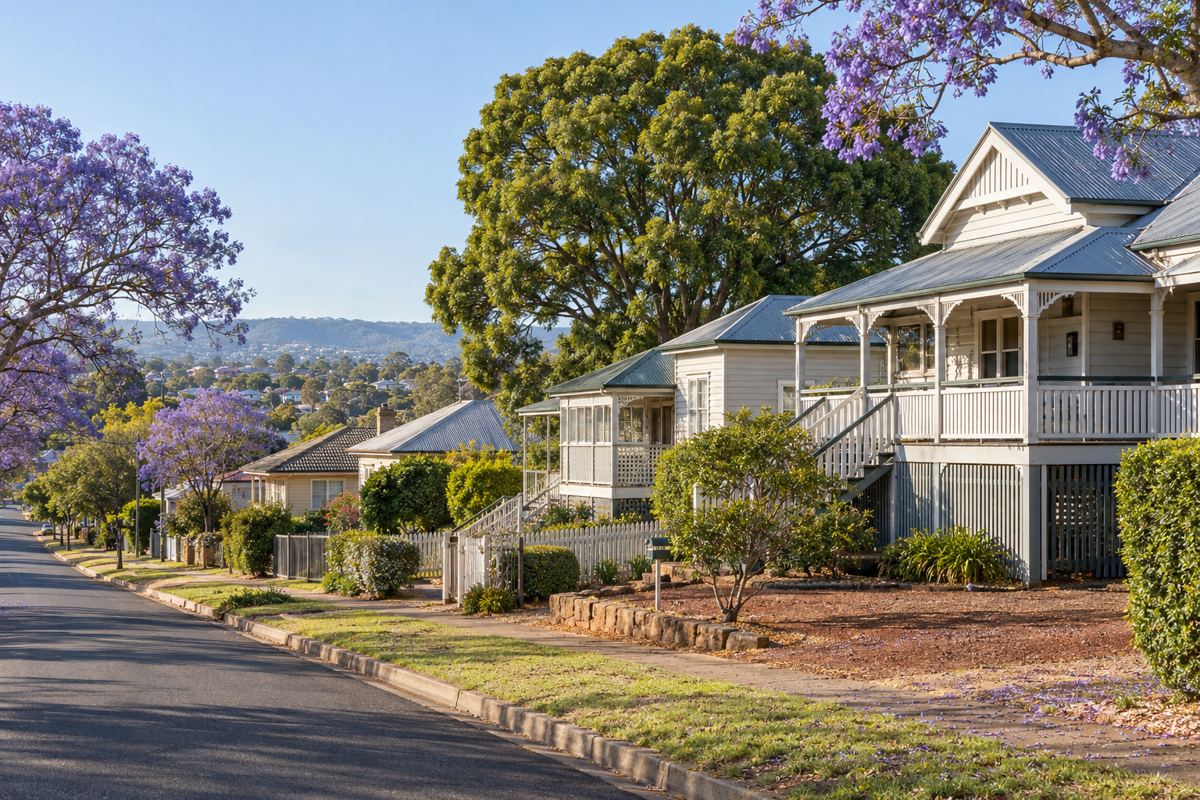
Toowoomba was founded in 1849, became a municipality in 1860, got its railway in 1867 and was declared a city in 1904, and the housing stock reads like that timeline. Newtown was subdivided in 1865. East Toowoomba grew around Queens Park from 1869 and the Grammar School from 1877, and the Caledonian Estate east of the city centre was built in the timber Queenslander style. Harristown was cut up in 1902 and 1910 and filled in after the war; Rangeville and Wilsonton are largely post-war; Kearneys Spring is a suburb of the 1970s. A buyer looking at a high-set Queenslander with verandahs and lattice in East Toowoomba or Newtown is looking at a house that has been standing on stumps for a very long time.
That is not a reason to walk away. A Queenslander is a frame on posts, and the posts are replaceable. A house that has been restumped properly on concrete or steel can be in better shape underneath than a newer brick home on a slab that has moved on the clay. The point of this page is to work out, before the contract goes unconditional, which of those two houses you are buying.
The subfloor inspection
A standard pre-purchase building inspection looks at the stumps, but how closely depends on access and on the inspector. On a high-set house the inspector can walk under and probe every stump. On a low-set house with little clearance they may look through the vents and report what they can see. Ask the agent before you book which it is, and if the answer is a crawl space, ask the inspector to go in or to say in writing that they could not.
What a good subfloor report names:
- Stump material: hardwood, concrete, steel, or a mix, which tells you whether the house has been restumped before and how far.
- Stumps probed soft or hollow at the ground line, by location, not just "some stumps show deterioration".
- Leaning stumps and stumps packed with timber, brick or fibro between the stump top and the bearer.
- Bearers and joists with rot, sag or termite damage, and whether the inspector could reach them.
- Moisture: pooling, staining, a leaking shower waste, a downpipe discharging under the house, and whether the ground is red soil or black clay.
- Ant caps present or missing, and whether the subfloor is enclosed.
A report that says the stumps "require further investigation by a suitably qualified person" has told you nothing you can price. Get the suitably qualified person in before the finance date, and read the signs page first so you know what you are looking at when you walk through with them.
The pest inspection and the meter box
QBCC describes termites as a problem throughout Queensland and recommends a yearly inspection. A timber Queenslander on hardwood stumps is the house they like best, and a pest inspection is not optional in Toowoomba. It is usually done with the building inspection, and the pest inspector follows mud tubes up the stumps and taps the bearers and the bottom plates of the walls.
Open the meter box. The Building Code of Australia requires a termite management notice to be fixed there, and the National Construction Code's Queensland variation requires termite management with a 50-year design life on new work. The notice says what system was installed, when, and when it was last inspected. No notice means no record of management. A notice dated years ago with no inspection since tells you the yearly check has not happened. Either way the termites page explains what a restump does and does not fix.
| Before the contract goes unconditional | Why |
|---|---|
| Building inspection with the subfloor entered, not viewed through a vent | Stump condition and count is what the restump price depends on. |
| Pest inspection and a look at the meter box notice | Termites are a problem throughout Queensland and take bearers as well as stumps. |
| Building plan search with council | Council holds plans for approved work since 1975; a restump or a raise should be in them. |
| Heritage and character check on the register and the maps | Raising or enclosing a listed or character place can be assessable. |
| Flood hazard overlay check | Affects the floor level you must keep or reach if you raise, and whether you can build under. |
| QBCC insurance notice for any recent building work | Shows the work was done by a licensed contractor with home warranty cover. |
| Owner-builder disclosure | A seller who did work over $11,000 as owner-builder in the last six years must disclose it. |
| Restumper's own inspection and quote | Turns the report's wording into a stump count and a figure you can negotiate on. |
The plan search
Toowoomba Regional Council offers building plan searches for plans lodged since 1975. If the agent says the house was restumped or raised in the last few decades, the approval and the plans should be there. A full restump or any raise is assessable building work that needs a building development permit from a certifier, and the final inspection should have been done. Work that is not in the search was either done before 1975, done under the accepted development rules for a few stumps, or done without approval. The last of those is the one to find out about before you own it.
For work in the last few years ask the seller for the QBCC insurance notice. The Queensland Home Warranty Scheme covers residential building work over $3,300, the contractor pays the premium before work starts, and structural defects are covered for 6 years 6 months from the contract date. Cover attaches to the house, not to the owner, so a recent licensed restump brings its remaining cover with it. Ask also whether the seller did any work as an owner-builder: QBCC's rules require an owner-builder permit above $11,000, carry a notice on the title for seven years and require disclosure to a buyer within six years, and owner-builder work has no home warranty cover.
Heritage, character and the overlays
Toowoomba has 64 places on the Queensland Heritage Register, 29 of them in Toowoomba City, 10 in East Toowoomba and 7 in Newtown, and the planning scheme has its own register of Local Heritage Places and Neighbourhood Character Places. Council's register page is clear that Toowoomba does not use a blanket pre-1946 rule; the heritage overlay applies to specific nominated places, and the neighbourhood character overlay to mapped streetscape areas and specific character places, with the detail in Planning Scheme Policies 6 and 7.
What that means for a buyer: like-for-like restumping that does not change the house's appearance or height is usually outside the heritage and character codes. Raising the house, or changing the under-house enclosure from lattice to a built-in lower storey, can be assessable, and pulling a heritage or character place down is generally impact assessable. If your plan for the house is a raise and a build-under, check the overlays at maps.tr.qld.gov.au and ask council's planning team before you make the offer, not after.
Check the flood hazard overlay at the same time. Toowoomba flooded in December 2010 and again in January 2011, and the 10 January 2011 event was a flash flood that overwhelmed the East Creek and West Creek culverts through the city centre. Council's flood risk planning sets floor levels under the Flood Hazard Overlay Code: 300 mm above the defined flood event in low risk areas, where a house cannot be slab-on-ground, 500 mm in medium risk, 600 mm for overland flow, and no new buildings in high or extreme risk. A Queenslander on stumps in a low or medium risk area is the right kind of house for that ground, and raising it may be the right move, but the floor level you have to reach is set by council. The overlays page goes through all of it.
Turning the report into a number
A building report that flags the stumps gives you a reason to negotiate but not a figure. The figure comes from a restumper's inspection: every stump probed, every bearer sighted, the ground noted, and a quote that names the count, the stump type, the certifier and the home warranty premium. Most sellers will allow a second inspection before the finance date, and a quote in hand is a better bargaining position than a sentence in a report. The cost guide lists what the quote must name.
Then decide what you are buying. A house that needs a full restump on concrete or steel is a known job with a known paperwork trail: a licensed builder, a certifier, a Level 2 contract if the price is $20,000 or more, and six and a half years of structural cover from the contract date. A house that needs a handful of stumps is a smaller job the certifier may treat as accepted development. A house with sound stumps and a sagging floor may only need relevelling. A brick home on a slab with stepped cracks is a different conversation about underpinning. Knowing which one you have before you sign is the whole point of the inspection.
What this page cannot do
It cannot tell you whether a particular house is listed or sits under an overlay; council's register and the mapping at maps.tr.qld.gov.au do that, and council's planning team confirms it. It cannot tell you whether past work was approved; the plan search does that for work since 1975, and nothing does it for work before. It cannot read a building report for you or turn it into a price; a restumper's inspection does that. And it is not conveyancing advice: what a seller must disclose, what a contract condition should say and when the finance date falls are questions for your solicitor or conveyancer, who should see the building and pest reports before the contract goes unconditional.
Check the current rules before you rely on this
This page describes what a buyer should check under and around a Toowoomba Queenslander before settlement. It describes the rules in general terms as they stood in October 2026. Standards, forms, thresholds and fines change.
The authoritative sources are Toowoomba Regional Council, building plan searches, QBCC on termites in Queensland, Toowoomba Regional Council, register of heritage and neighbourhood character places, Toowoomba Regional Council, flood risk planning, QBCC, what is the Queensland Home Warranty Scheme and QBCC, owner-builder permits. Where anything here differs from those sources, they are right and we are not.
We are not building certifiers, engineers, planners or lawyers. For what applies to your house, ask a licensed building certifier or ring Toowoomba Regional Council on 131 872.
Accurate at the time of writing, October 2026. Always check the source before relying on it.